Windshield chip repair in Ottawa, done before it runs
A rock chip is the cheapest windshield problem you will ever have, for about a week. Fill it with resin while it is small and clean, and it stays a chip. Leave it through one Ottawa cold snap, and it can become a crack across your view.
At a glance
- Takes
- Usually under an hour, often about 30 minutes
- Where
- At your home, your work or wherever the car is parked
- Repairable
- Most chips up to about a loonie, star breaks up to about 7.5 cm
- Insurance
- Often covered with no deductible under comprehensive
- Drive away
- Straight after the repair
Why a chip is worth fixing this week
A windshield is two sheets of glass bonded to a clear plastic layer in the middle. When a stone hits it at highway speed, it almost always breaks only the outer sheet. You are left with a small crater, sometimes with a ring around it, sometimes with fine legs running out from it. That is a chip, and it is the whole reason windshield chip repair exists: the damage is real, but it is shallow, and the glass around it is still sound.
The trouble is that a chip is also a stress point in a sheet of glass that is under stress all the time. A windshield is curved, bonded to the body along its edge, and it carries load every time the car twists over a pothole or a curb. Any of that load that reaches the chip gathers at the tips of its legs. Add an Ottawa morning, with glass frozen overnight and the defroster blowing warm air on the inside, and the outer and inner faces of the glass expand by different amounts. That is usually the moment a chip becomes a crack.
Time works against you in a quieter way too. An open chip collects water, washer fluid, road salt and the fine grit that coats every car in an Ottawa winter. The more of that is trapped in the break, the harder it is for resin to reach the tips of the legs, and the more visible the finished repair will be. A chip repaired in the first few days usually turns out far better than the same chip repaired after a month on the road.
Finally, there is the money. A repair costs a fraction of a new windshield, and many insurers will cover it without a deductible because it saves them the price of the glass. A crack that has run past the point of repair costs you the deductible, a day of your time and, on many newer cars, a camera recalibration. Few decisions about a car are as one-sided.
What can be repaired, and what cannot
Most of the auto glass trade works from ROLAGS, the Repair of Laminated Automotive Glass Standard. It sorts damage by type and gives commonly cited limits for each. They are a guide rather than a law, and a careful technician will sometimes say no to a chip that is inside them, because of where it is or how dirty it has become.
Size is only half of the answer. A small chip at the very edge of the glass sits where the stress is highest, and it tends to run whatever is done to it. A chip right in front of the driver can be repaired, but even a good repair leaves a faint mark, and some drivers would rather not look through that every day. And a chip in the area the forward camera looks through is usually a reason for new glass, because a repair can bend the camera's view.
If you are not sure, the repair checker on the main page walks through type, size and location in three taps. Or send a photo with a coin beside the chip, and you will get a straight answer.
The usual limits
- Bullseye
- A round, cone-shaped break, sometimes with a dark ring. Repairable up to about 2.5 cm across, roughly the size of a loonie.
- Half-moon
- Like a bullseye but only part of a circle. The same limit, about 2.5 cm.
- Star break
- A small impact point with legs running out from it. Repairable up to about 7.5 cm across, legs included.
- Combination break
- A bullseye with legs. Repairable when the main body is up to about 5 cm.
- Short crack
- A single line, often started by a chip. Can often be stopped and filled when it is short and away from the edge.
- Not repairable
- Breaks at the edge, breaks on the inside layer or through both layers, and damage in front of a camera or sensor.
Based on commonly cited ROLAGS limits. The technician makes the final call once they see the glass.
Can your windshield be repaired?
Three taps: what the damage looks like, how big it is, and where it is. The answer uses the same limits most technicians work from.
1What does it look like?
2How big is it?
3Where is it? Tap the windshield.
Nothing tapped yet
Pick the type of damage, its size and where it sits, and you will see whether it can usually be repaired.
Call 613-851-7831How a windshield chip repair is done
A repair takes five steps. Done properly, the break is filled all the way to the tip of every leg, and then sealed so nothing can get back in.
Inspect and clean
The chip is looked at under light and magnification to check its type, size and depth, and to make sure the inner layer is intact. Loose glass is picked out of the impact point and the surface is cleaned.
Dry it out
Water trapped in the break stops resin from bonding, and in winter it may be frozen. The glass is warmed gently, never with a blast of heat, and the break is dried.
Mount the bridge
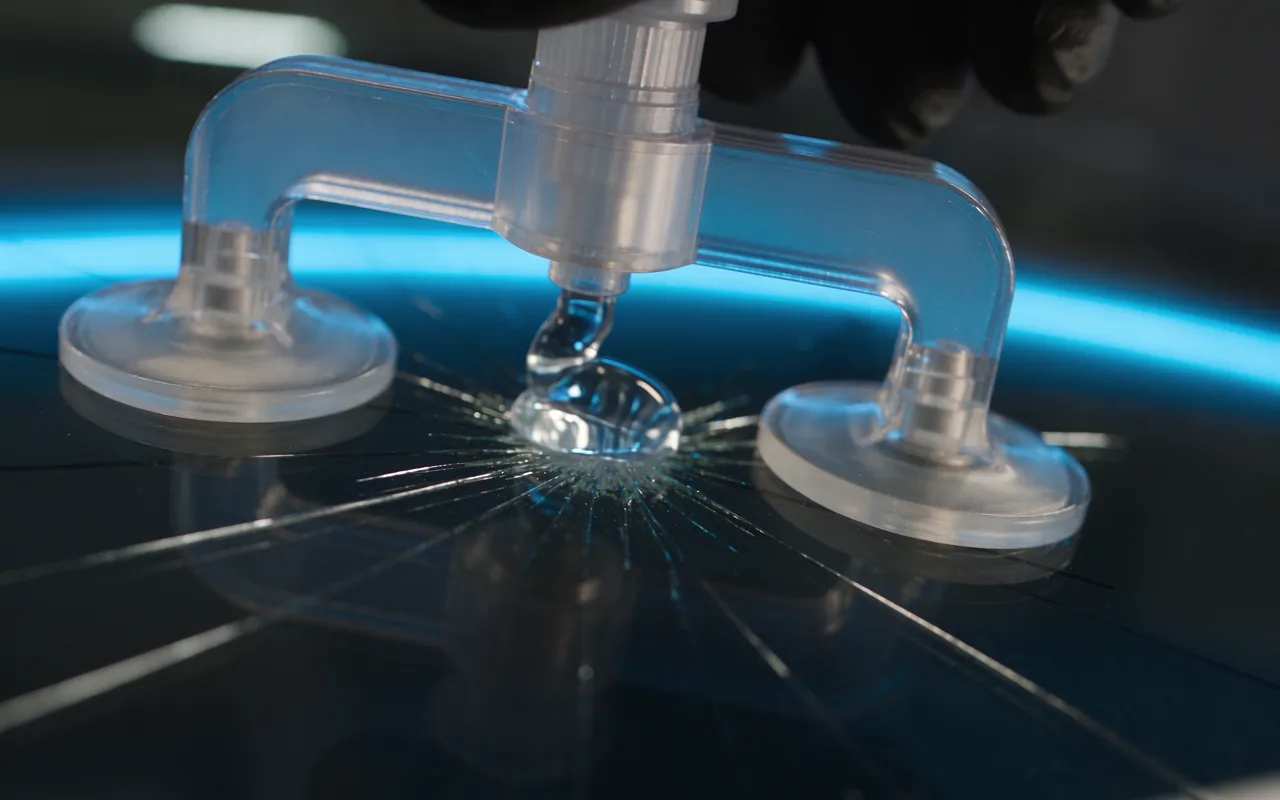
A small tool called a bridge is fixed to the glass with suction cups, with an injector sitting exactly over the impact point.
Vacuum, then pressure
The injector pulls a vacuum to draw out air, then pushes clear resin into the break under pressure. The cycle is repeated until the resin reaches the end of every leg, which you can watch happen as the legs go clear.
Cure and finish
A thin film is placed over the resin and an ultraviolet lamp cures it hard in a few minutes. The excess is scraped flush with a razor blade and the surface is polished.
What you see when it is done
Expect the chip to become much harder to see, not to disappear. Resin bends light almost exactly the way glass does, so once the air is out of the break most of the sparkle goes with it. What often remains is a faint mark at the point of impact, where a tiny piece of glass was knocked out. From the driver's seat, most people have to look for it.
How clear the result is depends mostly on two things: how fresh the chip was, and how clean. A chip repaired in the week it happened is usually the best case. One that has spent a month filling with salty water and road film usually shows more, because some of that dirt stays in the break.
What matters most is not the look but the strength. A properly filled chip is bonded shut. It can no longer take in water, and the legs can no longer grow, so the windshield keeps doing its job. If a repaired chip ever does run, a reputable shop will tell you up front what their guarantee covers.
Chips in an Ottawa winter
Winter is when most chips happen and when most of them spread. A few habits make the difference between a chip and a crack.
Do-it-yourself kits, and why they disappoint
Hardware stores sell chip repair kits for a few dollars, and on a fresh, small, clean bullseye on a warm day they can do a passable job. The problem is everything else. A kit has no way to pull a proper vacuum, so air stays in the legs of a star break. Its resin is a one-size product, while a technician chooses resin by the type of break and the temperature of the glass. And the curing step depends on the weather, which in an Ottawa November means it often does not cure well at all.
The bigger risk is what happens if it fails. Resin that has gone into a break cannot be taken out again, so a botched kit repair usually cannot be redone by a professional. A chip that would have been a straightforward repair becomes a windshield that has to be replaced.
If your insurer covers chip repair without a deductible, a professional repair may cost you nothing at all, which makes the kit the more expensive option. Check your policy, or use the claim calculator on the main page.
Checking Ottawa…
Live for Ottawa · next 7 days
Crack-risk forecast
This reads the Ottawa forecast and tells you how hard the week will be on a chipped windshield.
- –Coldest night
- –Biggest swing in a day
- –Freeze-thaw days
Forecast from Open-Meteo. A guide to the weather, not to your glass.
Insurance and chip repair in Ontario
A chip from a stone falls under the comprehensive part of an Ontario car insurance policy, the part that covers damage other than collisions. If you only carry the mandatory coverage and collision, glass damage usually is not covered, and the repair is simply paid for.
With comprehensive coverage, many insurers repair chips without charging a deductible. It is good business for them: a repair costs a small fraction of a new windshield, and every chip that is repaired is one that will not become a replacement claim. Not every policy works that way, so check yours or ask your broker.
A glass claim is not an at-fault accident. That said, every insurer treats claims history in its own way, so if you are unsure, ask before you claim. You can choose who repairs your car; your insurer may suggest a shop, but you do not have to use it.
Before you claim
- Check the coverage
- Look for comprehensive coverage, or all perils, on your policy. Glass damage falls under it.
- Check the deductible
- Some policies waive it for chip repairs. Others have a separate, lower glass deductible.
- Compare the numbers
- If the repair costs less than your deductible, a claim pays nothing. Pay for it yourself.
- Keep the details
- Note the date and the road where it happened. The claim usually starts with a phone call.
General information, not insurance advice. Your policy wording decides.
Questions people ask
How long does a windshield chip repair take?
Most take under an hour, often about 30 minutes for a single chip. Several chips on the same windshield take a little longer. You can usually drive away as soon as the repair is finished.
How big a chip can be repaired?
Commonly cited limits are about 2.5 cm, roughly a loonie, for a bullseye or half-moon, about 7.5 cm across for a star break including its legs, and about 5 cm for the body of a combination break. Location and cleanliness matter as much as size.
Will the chip be invisible afterwards?
Usually not completely. It becomes much harder to see, but a faint mark often remains where the stone hit. Fresh, clean chips give the best results.
Can a chip be repaired in the cold?
Yes, as long as the glass is dry and not frozen. In deep cold the glass is warmed slowly first, or the car is moved under cover. Sudden heat is avoided, because it can make the chip run.
Does insurance cover chip repair?
If you have comprehensive coverage, often yes, and many insurers waive the deductible for repairs. Check your policy or ask your broker.
Can a chip in front of the driver be repaired?
Often it can, but even a good repair may leave a faint mark in your line of sight. Some drivers choose a new windshield instead. The technician will tell you what to expect.
What if the repair does not hold?
A properly done repair seldom runs. Ask what guarantee comes with the work before it starts, so you know what happens if it ever does.
Should I tape over the chip?
Yes. A piece of clear tape over a fresh chip keeps water and dirt out until it is repaired, which makes for a better result.
More from Ottawa Windshield Repair
For everything else, from side windows to insurance claims, see the main page for windshield repair in Ottawa, or go straight to a service.
Tell us about the damage
613-851-7831Call for the quickest answer, or send the form with the car and where the damage is. You will get a call back with a recommendation and a price.