Windshield replacement in Ottawa, bonded and calibrated
When a crack has run too far, sits at the edge or crosses the camera's view, a new windshield is the safe answer. It is fitted with the right glass for your car, bonded to a clean frame, and the safety camera behind it is recalibrated before you drive away.
At a glance
- Takes
- About 1 to 2 hours, plus the adhesive's drive-away time
- Where
- At your home or work, or under cover in deep cold
- Glass
- The car maker's glass or equivalent glass built to the same specification
- Camera
- Recalibrated when the car has a forward camera
- Insurance
- Usually covered under comprehensive, minus your deductible
When a windshield has to be replaced
A windshield is replaced when a repair would not be safe or would not last. The most common reason is a crack that has grown too long: past roughly 15 cm, most shops will not repair it, and long-crack repair has its limits too. The second is location. A break within a few centimetres of the edge sits where the glass is under the most stress, and it tends to keep running. A break right in front of the driver can be repaired, but some drivers would rather not look through the mark it leaves.
There are reasons that have nothing to do with size. If the inner layer of glass is broken, which you can feel with a fingertip from inside the car, a repair cannot reach it. If the damage is in the area the forward camera looks through, a repair can distort the camera's view, so new glass is the safe choice. And if the windshield is pitted and sandblasted after years on gravel roads, it can glare badly at night even with no single crack in it.
Finally, there are the rules. A crack that blocks the driver's view can get you stopped on an Ontario road, and damage in the area swept by the wipers that affects the driver's view is a common reason for a car to fail the Safety Standards Certificate needed to sell or register a used car. If you are selling, a replacement is often part of getting the safety.
Getting the right glass for your car
Not every windshield for the same model is the same. Two cars that look identical can need different glass because of the options fitted at the factory. Matching them matters, because a feature that does not work after a replacement usually means the wrong glass went in.
You will hear about two kinds of glass. OEM glass comes from the supplier that makes it for the car maker, often with the car maker's logo on it. Equivalent glass, sometimes called OEE or aftermarket, is made by other manufacturers to the same shape and specification. Both must meet Canada's motor vehicle safety standard for glazing materials, and a good shop will tell you which one you are getting and why.
For cars with a forward camera or a head-up display, the optical quality of the glass in front of the camera and the projector matters more than usual. Some car makers recommend their own glass for those cars. It is worth asking about before the glass is ordered.
Features that change the glass
- Forward camera bracket
- A mount bonded to the glass behind the mirror, plus a frit patch around it. The camera needs recalibration after replacement.
- Rain and light sensor
- Needs a gel pad or a clear window in the frit so the sensor can see through the glass.
- Head-up display
- Special glass that keeps the projected image from doubling. Ordinary glass gives a ghosted image.
- Heated wiper park area
- Fine heating elements along the bottom edge that stop the wipers freezing to the glass.
- Acoustic interlayer
- A sound-damping plastic layer that keeps the cabin quieter at highway speed.
- Solar coating and tint band
- Infrared-reflecting coatings and the shaded band across the top.
Your car's VIN usually tells the shop exactly which glass to order.
How a windshield is replaced
A windshield is a structural part of the car, not a window. It is held in place by a bead of urethane adhesive, and that bond is what keeps it in place in a crash.
Protect the car
The hood, fenders and dashboard are covered. Wipers, the cowl panel under them, mouldings and the mirror and sensors on the old glass are taken off.
Cut out the old glass
The old urethane is cut with wire or cold knives, and the windshield is lifted out. A thin, even layer of the old urethane is usually left on the frame as a base.
Prepare the frame
The metal frame, called the pinch weld, is checked for scratches and rust. Salt from Ottawa winters can rust it under the old glass, and rust has to be treated and primed or the new bond can fail.
Prime and bond
The new glass is cleaned and primed where the urethane will meet it, and a fresh, even bead of urethane is laid around the frame.
Set the glass
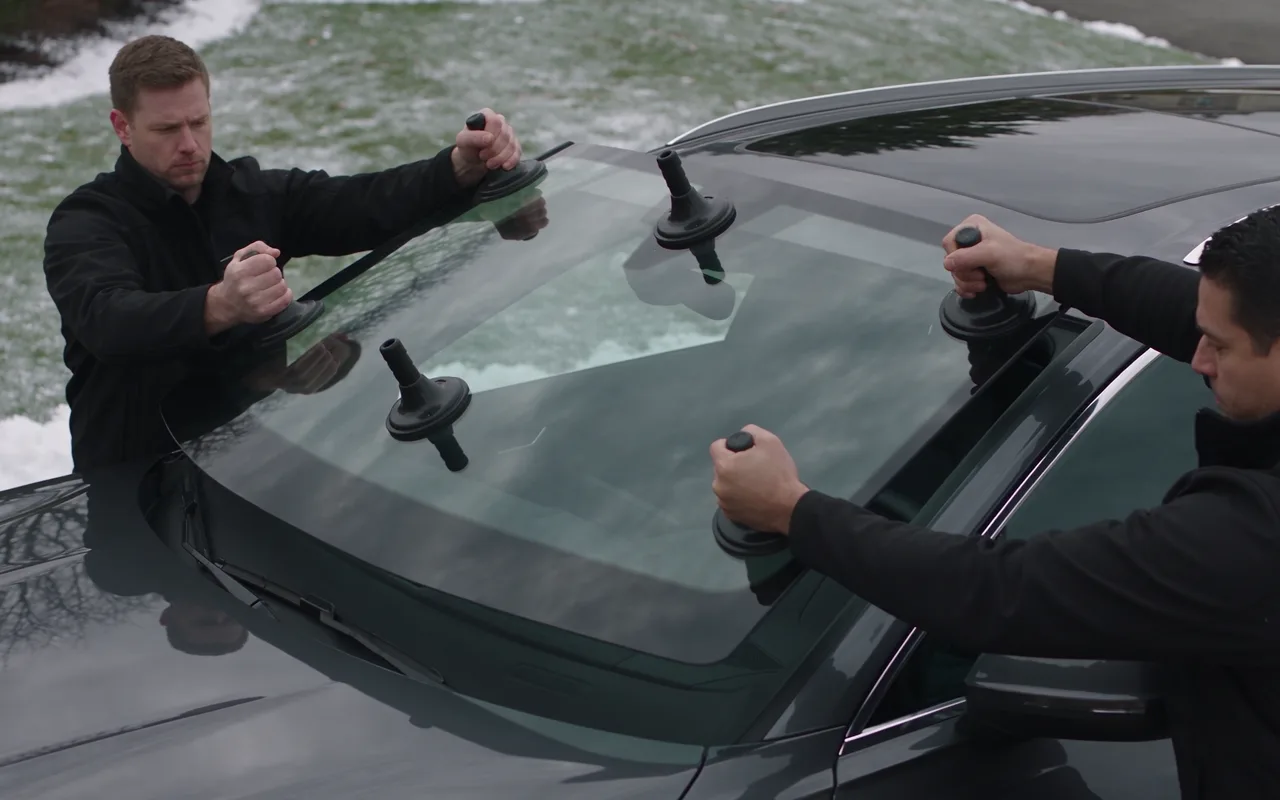
The windshield is lowered into place with suction-cup handles, centred, and pressed into the bead. Mouldings, the cowl and the wipers go back on, along with the camera and sensors.
Calibrate and check
If the car has a forward camera, it is recalibrated. The car is checked for warning lights, leaks and wind noise, and you are told when it is safe to drive.
The camera behind your mirror
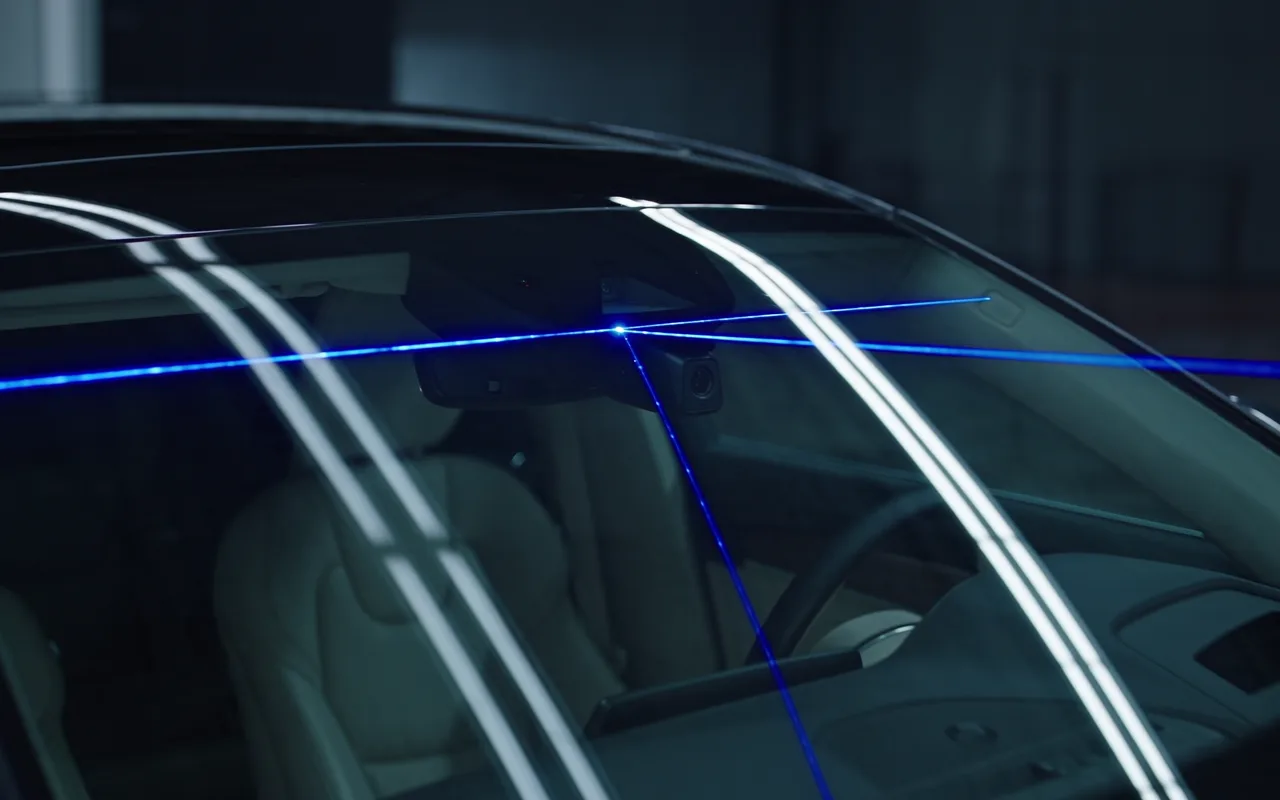
Most cars built in recent years have a forward-facing camera behind the windshield, in a black housing near the mirror. It reads lane markings, signs and the car ahead, and it runs lane keeping assist, lane departure warning, automatic emergency braking, adaptive cruise control and automatic high beams on many models.
The camera is mounted to a bracket bonded to the glass, so a new windshield moves it, even if only slightly. At highway speed, a fraction of a degree is the difference between the car seeing its own lane and the next one. CBC News reported the case of a driver who said his car steered toward oncoming traffic after a windshield replacement without recalibration, and Transport Canada said it had received reports of driver-assistance systems affected after a windshield was replaced.
Recalibration resets the camera to where the car maker says it should look. A static calibration is done with the car parked in front of a target board set at measured distances. A dynamic calibration is done on the road, driving at a set speed on clearly marked lanes. Some cars need one, some the other, and some both. On cars that need it, it is a required part of the job, not an extra.
Will your car need its camera recalibrated?
Four quick questions about your car.
- Does it warn you, or steer you back, when you drift out of your lane?
- Can it brake on its own for a car or a person ahead?
- Is there a black box behind the glass, next to the mirror?
- Does it read speed signs or dim the high beams by itself?
Tap yes or no for each one.
Safe drive-away time, and the first 24 hours
Urethane does not dry; it cures, by reacting with moisture in the air. Until it has cured enough, the windshield is not held strongly enough to stay in place in a crash or to support the passenger airbag, which on many cars deploys against the glass. The time it needs is the safe drive-away time, and it is set by the urethane's maker.
That time varies a great deal. Some fast-curing urethanes are rated safe to drive in about an hour, even well below freezing. Others need several hours, and most cure more slowly in cold, dry air. A good installer chooses the product with the day's weather in mind, and tells you a specific time. If anyone tells you that you can drive away immediately without knowing the product, be careful.
Full strength takes longer than the drive-away time, often a day or more. The first day is when the bond is most easily disturbed.
For the first day
- Leave the tape on
- Retention tape holds the mouldings while the urethane sets. Take it off when you are told to.
- Close doors gently
- Slamming a door with the windows shut pushes air against the new glass. Leave a window open a crack.
- Skip the car wash
- High-pressure water at the edge of the glass can work into a fresh bond.
- Avoid rough roads
- If you can, stay off gravel roads, potholes and steep driveways for the first day.
Follow the specific instructions you are given. They depend on the adhesive used.
Paying for a new windshield
Glass damage falls under the comprehensive part of an Ontario car insurance policy. With comprehensive coverage, a replacement is usually covered minus your deductible, and the camera recalibration the car needs is normally part of the same claim. Some policies have a separate, lower deductible for glass. If you only carry the mandatory coverage and collision, a windshield is not usually covered.
The price of a windshield has changed a great deal in recent years. Glass for a car with a camera bracket, a rain sensor, a heated wiper area or a head-up display costs considerably more than plain glass, before calibration is added. That is why a claim usually makes more sense for a replacement than it does for a repair.
Use the calculator below with your quote and your deductible. If you are unsure how a claim might affect your insurance, ask your broker before you claim; a glass claim is not an at-fault accident, but every insurer treats claims history its own way.
Claim or pay? Run your numbers
Enter the price you were quoted and your deductible.
Signs a windshield was not fitted properly
Most replacements go without a hitch. These are the signs that something needs to be looked at again, by the installer, under their guarantee.
Side and rear glass
Not every broken window is a windshield. Side and rear glass works differently, and is replaced rather than repaired.
Questions people ask
How long does a windshield replacement take?
Usually about one to two hours of work, plus the adhesive's safe drive-away time and any calibration. You will be told when the car is safe to drive.
When can I drive after a windshield replacement?
When the urethane has reached its safe drive-away time. Depending on the product and the weather, that can be about an hour or several hours. Ask for a specific time.
Does my car need a camera recalibration?
If it has a forward camera behind the windshield, near the mirror, it almost certainly does. That camera runs features like lane keeping assist and automatic emergency braking.
Is aftermarket glass safe?
Glass sold for Canadian cars must meet Canada's safety standard for glazing materials. For cars with cameras or head-up displays, ask which glass you are getting, as some car makers recommend their own.
Will insurance pay for a new windshield?
With comprehensive coverage, usually yes, minus your deductible. Calibration is normally part of the same claim. Check your policy.
Can a windshield be replaced in the winter?
Yes. The urethane is chosen for the temperature, and in deep cold the work may be done under cover so the adhesive cures properly. The drive-away time may be longer.
Can I wash my car after a replacement?
Wait at least a day before a car wash, and avoid pressure washing around the edges of the glass.
What about rust on the frame?
Ottawa's road salt can rust the frame under the old glass. It must be treated before the new windshield is bonded, or the bond can fail.
More from Ottawa Windshield Repair
For everything else, from side windows to insurance claims, see the main page for windshield repair in Ottawa, or go straight to a service.
Tell us about the damage
613-851-7831Call for the quickest answer, or send the form with the car and where the damage is. You will get a call back with a recommendation and a price.